
Local Control vs. Cloud Control: A Privacy Trade-Off Worth Understanding
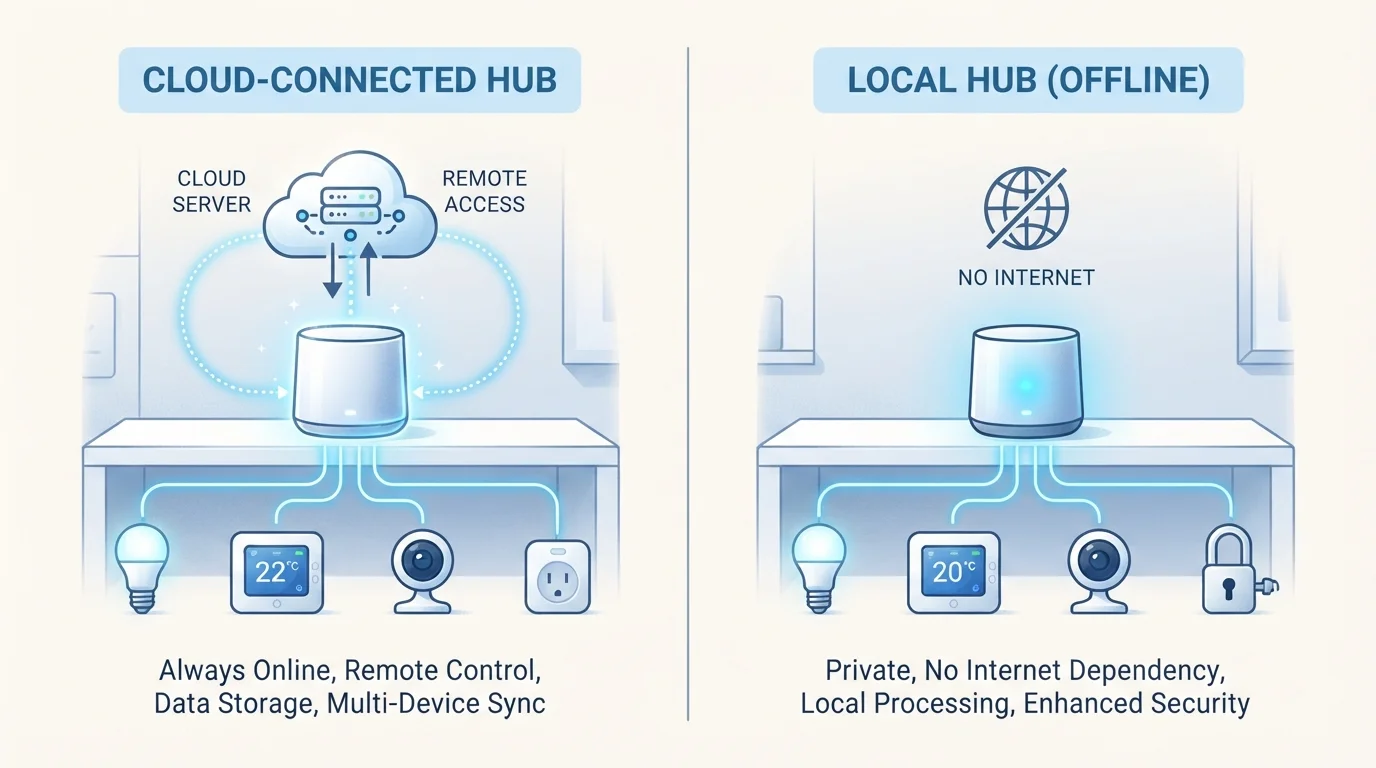
Photo credit: FindersGroove.com | Discover Important Information
In this article
Some smart devices need the internet to function; others work entirely offline. Here's what each approach means for privacy and reliability.
Key Takeaways
- Local control keeps your device data on your home network, not on a company's servers.
- Cloud control enables remote access and third-party integrations but sends data offsite.
- Cloud-dependent devices can stop working if the provider shuts down or changes its service.
- Local systems require more technical setup but offer greater long-term stability.
- Many modern devices support both modes, letting you choose your own privacy trade-off.
What These Two Approaches Actually Mean
When a smart device operates under local control, it processes commands and stores data entirely within your home network. Your phone sends an instruction to a hub or directly to the device - no data leaves your router. Under cloud control, that same instruction travels out to the manufacturer's servers, gets processed there, and a response is sent back to your device. It's a round trip that can happen in milliseconds, but it means your activity data is passing through infrastructure you don't own.
This isn't inherently sinister - cloud infrastructure enables real capabilities. But understanding the difference is the first step to making a deliberate choice. For a broader grounding in how smart home devices communicate, see our smart home basics explainer.
| Criterion | Local Control | Cloud Control |
|---|---|---|
| Data storage location | Your home network only | Provider's remote servers |
| Works during internet outage | Yes, typically | No, usually not |
| Remote access from outside home | Limited / requires extra setup | Built-in via app |
| Setup complexity | Higher | Lower |
| Risk of service shutdown | Low | Higher |
| Voice assistant integration | Often limited | Broad support |
| Privacy exposure | Minimal | Varies by provider policy |
The Privacy Implications Are Concrete
Cloud-connected devices routinely collect usage patterns - when you turn on a light, how often you trigger a sensor, sometimes even ambient audio snippets. That data is governed by the provider's privacy policy, which can change. It may be shared with advertising partners, used to train machine-learning models, or exposed in a breach. These aren't hypothetical risks; they're documented patterns across the industry.
Local control sidesteps most of this. Because data doesn't leave your network, there's nothing for a remote server to store, analyze, or expose. The trade-off is that you give up features that depend on cloud processing - certain AI voice commands, cross-platform integrations, and remote access outside your home Wi-Fi. For a deeper look at the data landscape, this breakdown of what connected devices collect is worth reading.
53%
Smart home users concerned about data privacy
A 2023 Pew Research Center survey found that a majority of US adults who use smart home devices express concern about how their data is collected and used.
~30%
IoT devices transmitting data unencrypted
Security researchers at Palo Alto Networks found that a significant share of IoT device traffic in enterprise and home networks lacks encryption, increasing interception risk.
Reliability and Longevity: A Practical Lens
One underappreciated risk of cloud-dependent devices is service discontinuation. When a company closes, pivots, or simply decides to end a product line, devices that rely on their servers can be rendered non-functional - sometimes with little warning. This has happened across multiple product categories. A smart plug or thermostat you paid for can effectively stop working because a business decision was made in a boardroom you'll never enter.
Local systems don't face this particular vulnerability. As long as the hardware works and your home network is running, the device keeps functioning. That said, local setups aren't maintenance-free: firmware updates, hub software, and network configuration all need occasional attention. Think of it as trading one type of dependency (a vendor's server) for another (your own technical upkeep). For guidance on keeping that home network solid, these network security principles are a practical starting point.
Open Standards Are Changing the Landscape
The Matter protocol - backed by major platform providers - is designed to let smart home devices work across ecosystems and, in some configurations, operate locally without cloud dependency. Adoption is still growing, and not every device category is covered, but it signals that local-first options are becoming more mainstream. Check whether a device supports Matter before assuming it requires a persistent cloud connection.
Choosing What Works for Your Situation
The binary framing of "local vs. cloud" is useful for understanding the concepts, but in practice many devices offer both options. Some routers and smart home hubs allow you to block a device's outbound internet access entirely, effectively forcing local-only operation. Others support open communication standards that make local control accessible without deep technical expertise.
If you're building a smart home and want to keep your options open - avoiding lock-in to any single approach - this guide to avoiding ecosystem lock-in covers interoperability strategies worth considering. And for a more complete picture of the security landscape that surrounds all connected devices, the privacy and security realities of living with smart devices provides honest, practical context.
Neither local nor cloud control is universally superior. The right call depends on what you actually care about: seamless convenience and remote access, or data sovereignty and long-term reliability. Name your priorities first - then let the technology follow.

Author
Tech & Gadgets Editorial Team
Tech & Gadgets Editorial Team is the collective byline for our editorial team and contributor network. Articles published under this byline or an editorial pen name are researched, written, and reviewed according to our editorial standards for clarity, consistency, and independence before publication.
View all articles →