
Scarcity, Social Proof, and the Subtle Tactics That Nudge You to Spend
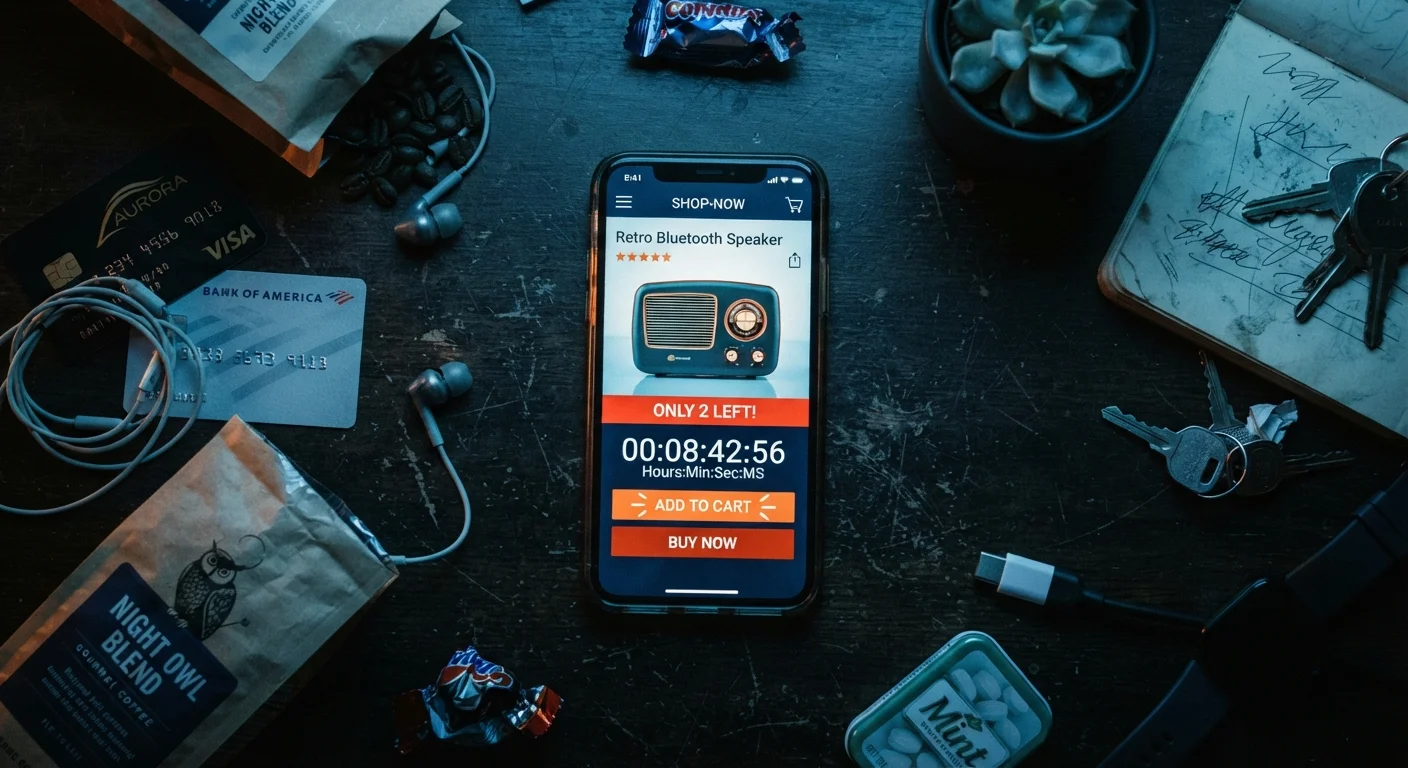
Photo credit: FindersGroove.com | Discover Important Information
In this article
Learn to recognise the design and marketing techniques that create urgency and how awareness of them can help you shop more deliberately.
The Tactics in Plain Sight
Every time you see "Only 3 left in stock," a countdown clock ticking toward zero, or a badge reading "127 people viewing this right now," you're encountering a deliberate design choice - not a neutral alert. These are persuasive design patterns, built on well-documented principles from behavioral economics and social psychology. Understanding them doesn't make you immune, but it gives you something more useful: the ability to pause before your instincts do the spending for you.
Retailers and platforms deploy a consistent toolkit. The most common tactics fall into a handful of categories that exploit how human decision-making actually works - fast, emotional, and heavily influenced by perceived social context. See our deep dive into urgency tactics for a closer look at how countdown timers specifically affect purchasing behavior.
| Core tactic categories | Scarcity, social proof, anchoring, loss aversion, and dark patterns |
| Where they appear | Product pages, checkout flows, loyalty programs, and personalized ads |
| Primary psychological lever | Loss aversion - fear of missing out outweighs anticipated gain (Kahneman & Tversky, Prospect Theory, 1979) |
| Effective counter-habit | Naming the tactic and applying a short wait period before purchasing |
| Social proof risk | Review counts and ratings can be gamed or reflect popularity, not fit |
Scarcity, Social Proof, and Anchoring - Defined
Three mechanisms underpin most nudge-based marketing. Knowing their names and mechanics is the first step to noticing them in the wild.
Scarcity effect
A cognitive bias in which people assign greater value to items they perceive as limited or disappearing. Retailers use low-stock warnings and countdown timers to trigger this response even when supply isn't genuinely constrained.
Social proof
The tendency to use others' behavior as a guide for our own decisions. In retail, it appears as review counts, bestseller labels, and purchase notifications that signal what 'most people' are choosing.
Anchoring
A bias where the first piece of information encountered (typically a high 'original' price) disproportionately shapes how subsequent prices are judged. A sale price only feels like a discount relative to its anchor.
Loss aversion
The well-documented human tendency to feel the pain of a loss more strongly than the pleasure of an equivalent gain. Scarcity and urgency tactics exploit this by framing inaction as missing out.
Dark pattern
A user interface design choice that manipulates users into actions they didn't intend - such as auto-enrolling in subscriptions, making cancellation confusing, or pre-selecting costly add-ons.
Persuasive design
The intentional use of psychology-backed interface and messaging choices to guide user behavior toward a specific outcome, typically a purchase or commitment.
Scarcity works because humans are wired to assign higher value to things perceived as rare or disappearing. When stock warnings appear, they convert a casual browser into a motivated buyer - even if the "scarcity" is exaggerated or artificial. Research in behavioral economics consistently shows that the fear of missing out outweighs equivalent anticipated pleasure, a pattern known as loss aversion.
Social proof operates on a simpler heuristic: if many other people chose this, it's probably the right call. Star ratings, review counts, "bestseller" labels, and live purchase notifications all activate this shortcut. The problem is that these signals can be gamed - reading reviews more critically explains how to evaluate them with more skepticism.
Anchoring occurs when the first price you see shapes how you judge every subsequent one. A crossed-out "original" price makes the sale price feel like a bargain regardless of whether the original price was ever real or fair. This is one of several cognitive biases that quietly shape your cart.
Where These Tactics Show Up
Persuasive patterns aren't limited to obvious flash-sale pages. They're embedded across the entire shopping journey:
- Product pages: Low-stock warnings, "trending" labels, and live viewer counts create urgency before you've even decided you want the item.
- Checkout flows: Auto-selected add-ons, last-minute upsells, and bundled "deals" appear when your guard is lowered and your wallet is already out. The checkout traps article covers these in detail.
- Loyalty programs: Points systems create a sunk-cost pull - you keep shopping at one retailer to "protect" accumulated rewards rather than because it's genuinely the best choice. Loyalty programs aren't always the deal they appear.
- Personalized ads: Platforms use behavioral data to show you exactly what you're most likely to want at the moment you're most likely to be susceptible. Understanding what platforms know about you is a practical starting point.
- Dark patterns: Design choices that make opting out harder than opting in - hidden unsubscribe flows, pre-ticked boxes, confusing cancellation screens. See dark patterns explained.
Not All Urgency Is Manufactured
Genuine limited stock, time-sensitive shipping cutoffs, and real sale deadlines do exist. The goal isn't to dismiss every scarcity signal - it's to verify before letting urgency override your judgment. If a product is truly right for you, that case should hold up even without a countdown clock.
Spending More Deliberately
Awareness is the foundation, but it needs to be paired with a concrete habit. A few practical anchors help:
- Name the tactic out loud (or in your head): "That's a scarcity warning." Labeling the mechanism interrupts the automatic emotional response.
- Apply a wait rule - even 10 minutes between seeing an item and purchasing it creates enough friction to filter out purely reactive buys.
- Ignore the anchor price and ask instead: What would I pay for this if I had no reference point? Does that number match what's being charged?
- Treat social proof as a starting point, not a conclusion. High review counts signal popularity, not suitability for your needs.
For a broader framework connecting these habits to your actual priorities, the value-based shopping guide walks through how to define what spending actually serves you - and filter out what doesn't. More consumer awareness resources are available across the hub.
~60%
Purchases reported as unplanned by shoppers
Multiple retail industry surveys consistently find that a majority of in-store and online purchases were not planned before the shopping session began.
2×
How much more loss hurts than gain feels good
Behavioral economics research originating with Kahneman and Tversky suggests losses are psychologically weighted roughly twice as heavily as equivalent gains.

Author
Smart Shopping Editorial Team
Smart Shopping Editorial Team is the collective byline for our editorial team and contributor network. Articles published under this byline or an editorial pen name are researched, written, and reviewed according to our editorial standards for clarity, consistency, and independence before publication.
View all articles →