
Social Proof or Social Pressure? Reading Reviews More Critically
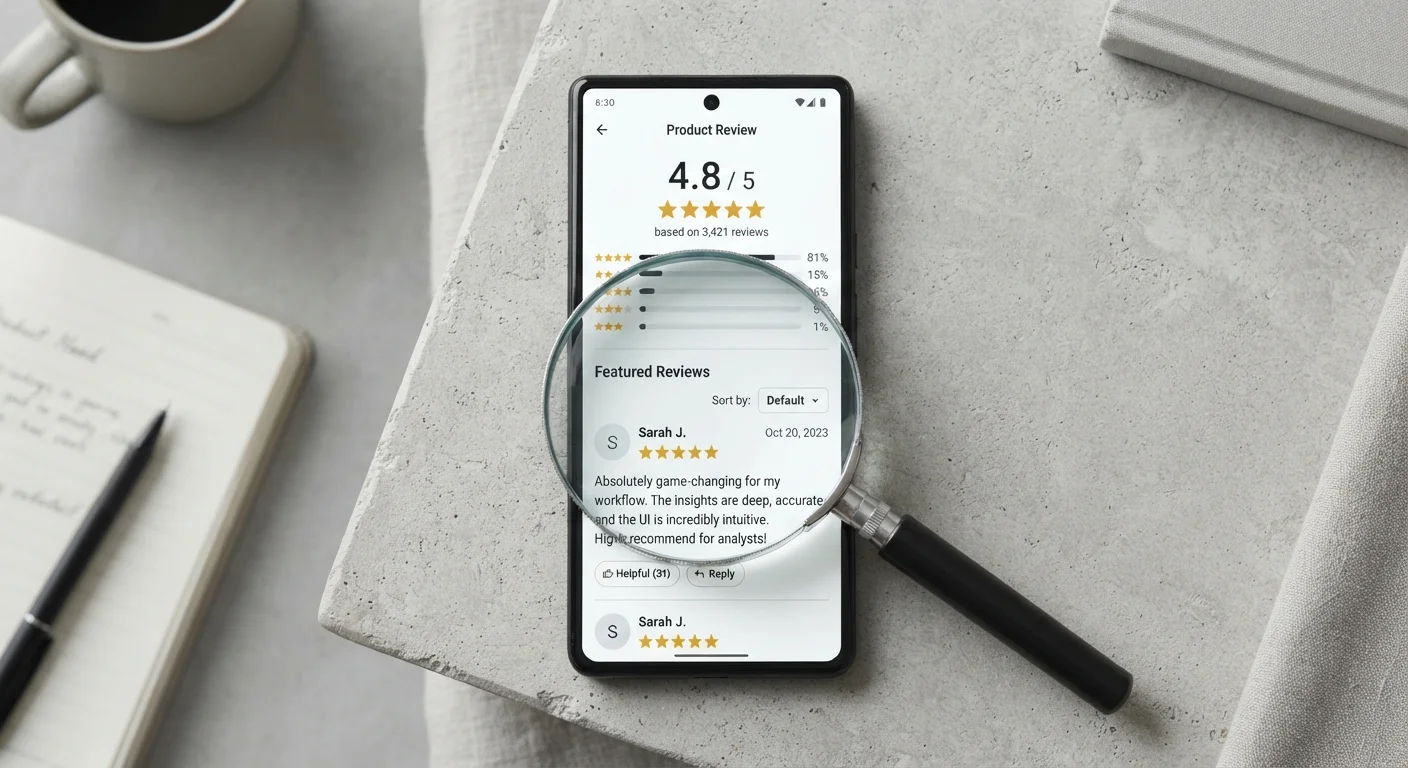
Photo credit: FindersGroove.com | Discover Important Information
Star ratings and testimonials feel reassuring, but they can be gamed. Here's how to assess reviews with a sharper eye.
Key Takeaways
- Aggregate star ratings can be inflated by incentivized, fake, or selectively displayed reviews.
- Reading the 2- and 3-star reviews often reveals more honest, specific product experiences.
- Review volume, recency spread, and reviewer history are reliable quality signals.
- Independent third-party testing cuts through platform-level manipulation more reliably than user ratings.
- Emotional language and generic phrasing are common markers of inauthentic reviews.
Why Reviews Aren't as Neutral as They Look
Online reviews have become one of the most trusted signals in consumer decision-making - and that trust is exactly what makes them a target for manipulation. The mechanics range from organized review farms generating fake accounts at scale, to sellers inserting package cards offering refunds in exchange for five-star feedback, to platforms selectively surfacing higher ratings through their own algorithms.
This isn't a fringe problem. Research consistently finds that a significant share of reviews on major retail platforms show signs of inauthenticity, and the regulatory environment - while evolving - has struggled to keep pace with the scale of the issue. Understanding the structural incentives at play helps you approach ratings with appropriate skepticism without dismissing them entirely. As part of a broader habit of mindful purchasing, reading reviews critically is one of the most practical skills you can build.
Reviews Can Be Purchased or Manipulated
The FTC has taken enforcement action against companies that paid for or otherwise incentivized reviews without proper disclosure. Platforms also face ongoing challenges with review farms - operations that generate fake feedback at scale. Treating any review ecosystem as fully neutral is not a safe assumption. Cross-referencing sources is the most reliable protection.
The same dynamics that distort reviews also shape other consumer signals. For a look at how marketing language itself can mislead, see our guide on reading product claims without being misled.
How to Read Reviews With a Sharper Eye
The steps below give you a repeatable process for evaluating any review set before you commit to a purchase. They work across retail platforms, app stores, and service marketplaces.
What you will need
Check the rating distribution, not just the average
Scroll past the headline star average and open the full rating breakdown - usually displayed as a bar chart. Healthy, organic review distributions tend to be uneven: a genuine product often has a cluster of 5-star reviews, a moderate 4-star group, and a visible tail of 1- and 2-star responses. A suspiciously "U-shaped" distribution (masses of 5s and 1s, almost nothing in between) can indicate coordinated boosting alongside competitor sabotage. A nearly perfect rating with almost no low reviews on a high-volume product is a red flag, not a reassurance.
Filter by recency and look for pattern shifts
Sort reviews chronologically and look for abrupt changes in average rating over time. A product that held 3.5 stars for two years and suddenly jumped to 4.7 after a specific date warrants scrutiny - this pattern sometimes follows a review-generation campaign. Conversely, a drop in recent ratings on a previously solid product can signal a change in manufacturing, materials, or customer service quality that the overall average hasn't yet caught up with.
Read 2- and 3-star reviews with attention
Mid-range reviews are often the most informationally dense. Writers of 2- and 3-star reviews typically bought the product, used it, and found it neither catastrophically bad nor entirely satisfying. They tend to describe specific features - fit, durability, smell, battery life, ease of assembly - in concrete terms. This specificity is exactly what you need to assess whether the product suits your use case, regardless of whether it satisfied the average buyer.
Evaluate the language quality of positive reviews
Authentic positive reviews tend to be specific, occasionally awkward, and personal. They reference real use scenarios: "I've been using this daily for six months and the zipper finally gave out" or "bought this for my dog who pulls hard on walks - works better than I expected." Generic phrasing like "Amazing product! Five stars! Highly recommend!" with no specifics is a common marker of incentivized or fabricated content. Excessive exclamation points, oddly formal sentence structure, and near-identical phrasing across multiple reviews are also worth flagging.
Check the reviewer's profile history
On platforms that allow it, click through to the reviewer's profile. A credible reviewer typically has a mixed history - some positive reviews, some negative ones, across diverse product categories over a realistic time span. A profile that has reviewed 40 products in one week, all five-star, all in the same category, is a strong signal of inauthenticity. Some platforms badge verified purchasers; while verification helps, it doesn't rule out incentivized reviews where a real purchase was made in exchange for a positive write-up.
Cross-reference with sources outside the platform
No single review platform is a complete picture. Search for the product name alongside terms like "problems," "issues," or "long-term" to surface forum threads, Reddit discussions, or independent blog posts from real owners. These environments have fewer incentives to skew positive and often contain candid long-term ownership experiences. For higher-stakes purchases, look for coverage from consumer-focused publications that disclose their testing methodology. This is especially valuable for electronics, appliances, and health-adjacent products.
Use Third-Party Review Aggregators
Sites that independently test products - rather than aggregate user-submitted ratings - are harder to game. Look for publications with disclosed testing methodologies and no affiliate relationship with the products they evaluate. This doesn't guarantee perfect objectivity, but it raises the baseline significantly compared to platform reviews alone.
High Review Count Doesn't Mean High Quality
A product with thousands of reviews can still be low quality if those reviews were gathered through incentive programs, bundled product inserts, or review exchanges. Volume signals popularity or marketing spend - not necessarily product merit. Always pair quantity with the quality indicators described in this guide.
For purchases influenced by influencer posts or social recommendations, these steps pair well with understanding the difference between influencer endorsements and independent recommendations. Review manipulation and influencer marketing often overlap - a product flooded with positive reviews may also be running a seeding campaign through paid social content.
It's also worth noting that the psychological pull of a high star rating is a form of social proof - a cognitive shortcut that marketers actively design around. Our article on subtle spending tactics explores the broader landscape of these nudges, including how awareness alone can meaningfully shift your behavior.
This article is for general informational and educational purposes only and does not constitute financial, legal, or consumer advice tailored to your specific situation.

Author
Smart Shopping Editorial Team
Smart Shopping Editorial Team is the collective byline for our editorial team and contributor network. Articles published under this byline or an editorial pen name are researched, written, and reviewed according to our editorial standards for clarity, consistency, and independence before publication.
View all articles →