
What Diversification Actually Means - and What It Doesn't Protect Against
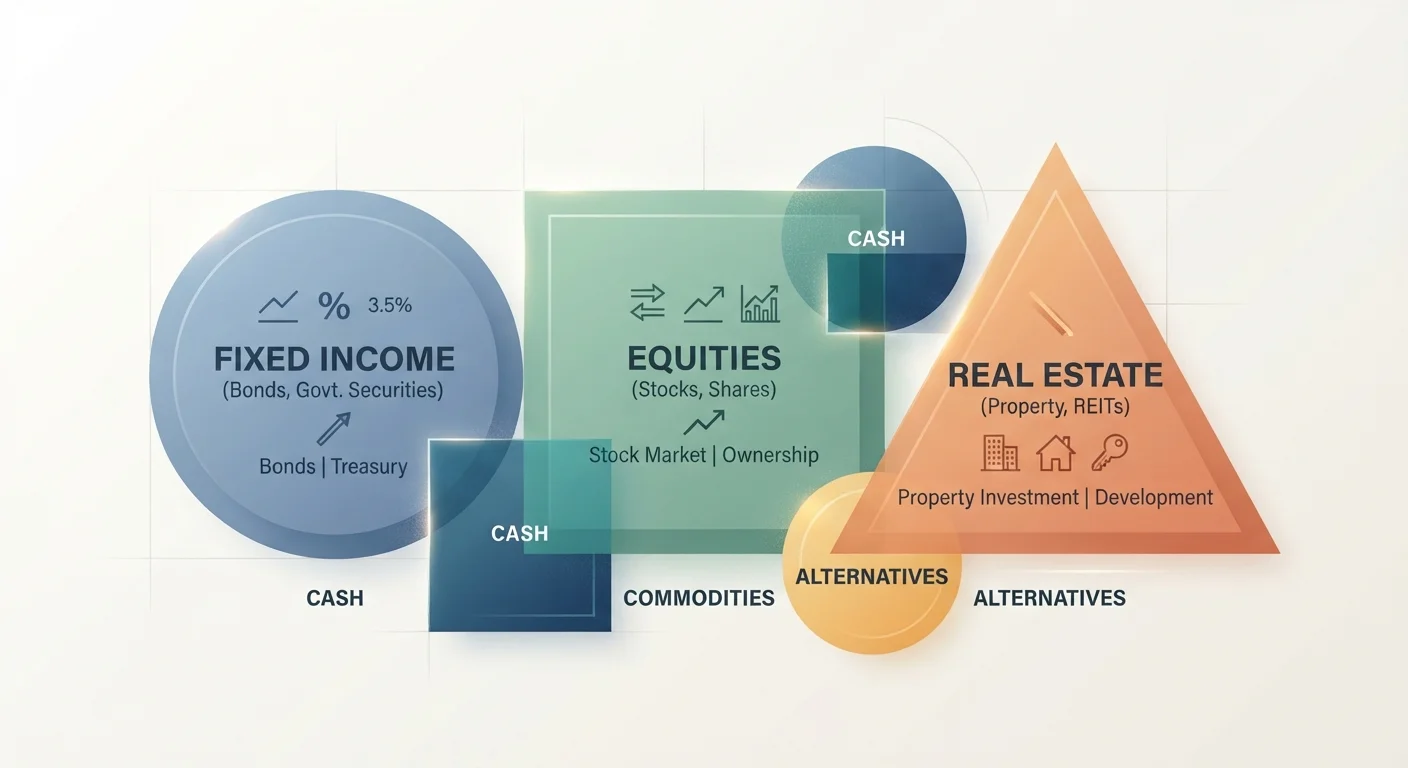
Photo credit: FindersGroove.com | Discover Important Information
In this article
Diversification reduces certain types of investment risk but doesn't eliminate it. This explainer clarifies what spreading assets can and cannot do.
Key Takeaways
- Diversification reduces company- or sector-specific risk, not overall market risk.
- Holding more assets doesn't automatically mean you're diversified - correlation matters.
- A portfolio of 20 tech stocks is concentrated, not diversified, despite its size.
- Broad market downturns affect nearly all assets, regardless of how spread out your holdings are.
- Diversification is a risk management tool, not a guarantee of positive returns.
The Core Idea Behind Diversification
At its simplest, diversification follows a familiar principle: don't put all your eggs in one basket. In investing, that means owning a mix of assets - different companies, sectors, or asset classes - so that when one investment falls in value, others may hold steady or even rise.
The mechanism works because different investments often respond differently to the same economic event. When airline stocks fall sharply due to rising fuel costs, utility stocks may be unaffected. When one country's economy contracts, markets elsewhere may continue growing. This lack of perfect alignment - called low correlation - is what gives diversification its power.
Understanding what diversification is really doing sets realistic expectations. It's not about finding the best investments. It's a deliberate strategy to manage the damage when something goes wrong - and in investing, something eventually always does. To ground this in a broader foundation, it helps to first understand how saving and investing differ, since diversification only applies once you're in the investing phase.
~20-30
Stocks needed to reduce most company-specific risk
Finance research has long suggested that a portfolio of roughly 20-30 uncorrelated stocks eliminates the majority of unsystematic risk, though the exact number depends on how varied the holdings are.
~500+
Companies in a broad U.S. total market index
Broad index funds tracking the total U.S. stock market hold hundreds to thousands of individual companies, providing wide company-level diversification within a single investment vehicle.
What Diversification Actually Reduces
Investment risk comes in two forms. Unsystematic risk (also called specific or idiosyncratic risk) is the risk tied to a particular company, industry, or region. If a single company faces a scandal, product failure, or bankruptcy, a concentrated investor absorbs the full blow. A diversified investor barely feels it.
Diversification works well against this type of risk. Spreading investments across many companies and sectors means no single failure can sink your portfolio. This is the core protection diversification provides - and it's genuinely valuable.
The second type - systematic risk - is where the limits begin.
“Diversification is the only free lunch in investing - but even a free lunch doesn't feed you during a famine.”
— Harry Markowitz, Nobel Prize-winning economist and pioneer of Modern Portfolio Theory
What Diversification Cannot Protect Against
Systematic risk is market-wide risk: recessions, interest rate shifts, inflation spikes, geopolitical crises, or global financial shocks. These events affect nearly every asset simultaneously, and no amount of spreading within the market removes this exposure.
During the 2008 financial crisis and the March 2020 market crash, broadly diversified portfolios still experienced significant declines - because the forces driving those downturns were economy-wide, not company-specific. Stocks, bonds, and real estate all fell in 2008. There was nowhere inside traditional asset classes to fully hide.
This is why it's accurate to say that diversification reduces risk, not eliminates it. Investors who believe a diversified portfolio protects them from all losses are likely to make panic decisions when broad declines hit - which is one of the most common mistakes beginner investors make.
Diversify Across Asset Classes, Not Just Stocks
Many investors spread across dozens of stocks while remaining 100% in equities - which still leaves them fully exposed to stock market downturns. Adding asset classes with different risk profiles, such as bonds or cash equivalents, builds a more complete layer of protection. The right mix depends on your personal goals and timeline - a financial adviser can help you think through what balance makes sense.
Common Misconceptions About Being 'Diversified'
Many investors think they're diversified when they're not. A few patterns worth recognizing:
- Owning many stocks in one sector isn't diversification. Twenty technology companies will likely fall together when the tech sector struggles.
- Holding multiple funds that track the same index adds no real spread - you own the same underlying assets twice.
- Ignoring asset class diversity leaves you exposed. Stocks and bonds often (though not always) move independently, which is why many portfolios include both.
True diversification means spreading across asset classes (stocks, bonds, cash equivalents, potentially real assets), sectors, and geographies - not simply accumulating more of the same thing. Just as earning more doesn't automatically improve your financial position, owning more investments doesn't automatically reduce your risk.
Using Diversification as Part of a Broader Strategy
Diversification is most effective when it's part of a deliberate plan. Consider your overall asset allocation - how you divide your portfolio among major categories like stocks, bonds, and cash - as the framework. Diversification is how you fill in the detail within that framework.
Your appropriate level of diversification depends on factors like your time horizon, risk tolerance, and financial goals. A 25-year-old saving for retirement decades away can typically absorb more equity risk than someone who will need their money in five years. These are personal decisions where a licensed financial adviser can provide guidance tailored to your situation.
What's clear for nearly every investor: understanding that diversification manages - but doesn't eliminate - risk leads to more realistic expectations and steadier behavior during volatile markets. That steadiness is often more valuable than any single investment decision.
This article is for general informational and educational purposes only and does not constitute personalized financial, investment, tax, or legal advice. Consult a qualified financial professional before making decisions based on your individual circumstances.
Frequently Asked Questions

Author
Money & Finance Editorial Team
Money & Finance Editorial Team is the collective byline for our editorial team and contributor network. Articles published under this byline or an editorial pen name are researched, written, and reviewed according to our editorial standards for clarity, consistency, and independence before publication.
View all articles →