
Index Funds vs. Actively Managed Funds: What Young Investors Should Understand
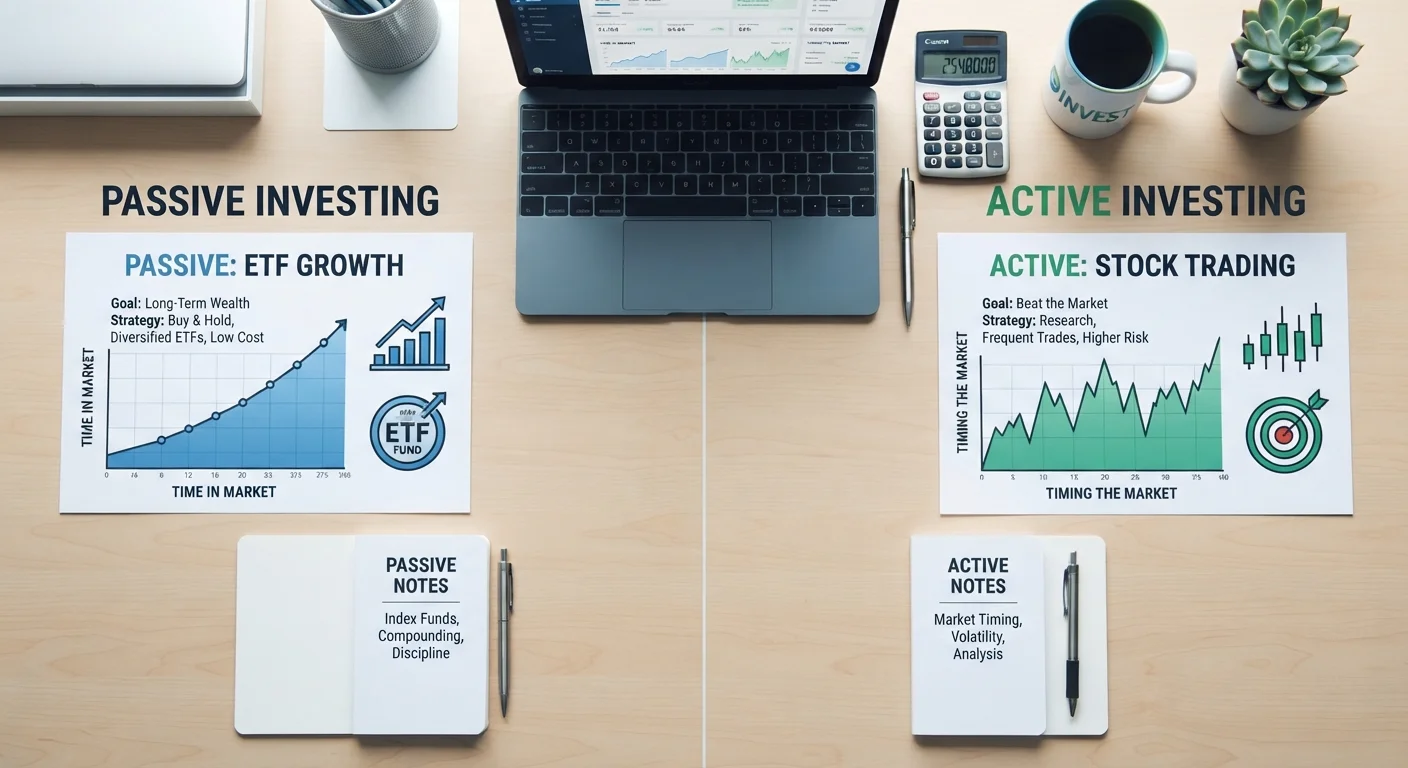
Photo credit: FindersGroove.com | Discover Important Information
In this article
Index funds and actively managed funds take very different approaches to growth. Here's a clear breakdown of how each works and what distinguishes them.
Key Takeaways
- Index funds track a market benchmark passively; actively managed funds rely on manager decisions to select holdings.
- Actively managed funds typically carry higher fees, which can meaningfully erode returns over decades.
- Research consistently shows most actively managed funds underperform their benchmark index over the long term.
- Neither approach is universally superior - your goals, timeline, and risk tolerance all matter.
- Costs (expense ratios) are one of the clearest predictors of long-term fund performance.
How Each Approach Works
Before comparing outcomes, it helps to understand the mechanics. An index fund is designed to replicate the performance of a specific market benchmark - such as the S&P 500 or a total stock market index. The fund holds the same securities as the index, in the same proportions, and adjusts only when the index itself changes. No manager is actively deciding what to buy or sell. This is called passive investing.
An actively managed fund works differently. A professional fund manager - backed by a team of analysts - continuously researches and selects securities they believe will outperform the market. The goal is to generate returns above what a passive index would deliver. This requires ongoing decision-making, research, and trading activity.
If you're new to investing altogether, the foundational concepts behind investing are worth reviewing before choosing between fund types.
| Criterion | Index Funds | Actively Managed Funds |
|---|---|---|
| Management style | Passive - tracks an index | Active - manager selects holdings |
| Typical expense ratio | Under 0.20% annually | 0.50%-1.00%+ annually |
| Goal | Match market performance | Beat market performance |
| Trading frequency | Low - changes only when index changes | Higher - ongoing buying and selling |
| Transparency | High - holdings mirror the index | Variable - disclosed periodically |
| Long-term performance (historical) | Outperforms majority of active funds | Most underperform benchmark net of fees |
| Suitable for beginners | Generally yes | Requires more due diligence |
The Fee Gap and Why It Compounds
One of the most consequential differences between these two fund types is cost. Index funds typically carry very low expense ratios - the annual fee expressed as a percentage of your investment. Many broad market index funds charge below 0.10% annually. Actively managed funds, by contrast, often charge between 0.50% and 1.00% or more, reflecting the cost of research teams, trading activity, and management.
That gap may sound small, but over decades it compounds significantly. On a $10,000 investment growing at 7% annually over 30 years, the difference between a 0.10% and a 0.75% expense ratio translates to thousands of dollars in lost returns - money that never had the chance to compound.
~85%
Active large-cap funds underperforming S&P 500
According to S&P Dow Jones Indices SPIVA data, roughly 85% of actively managed U.S. large-cap funds underperformed the S&P 500 over a 15-year period.
0.03%-0.10%
Typical index fund expense ratio range
Many broad market index funds available in the U.S. charge annual expense ratios well under 0.10%, according to industry fund data.
~0.66%
Average actively managed equity fund expense ratio
Morningstar's fund fee research has reported average expense ratios for actively managed equity funds in the range of 0.60%-0.70% annually.
The Consumer Financial Protection Bureau (CFPB) and independent research organizations like Morningstar have consistently highlighted fund expenses as one of the most reliable predictors of relative fund performance. Lower costs don't guarantee higher returns, but they reduce the drag on every dollar you invest.
The Performance Question
The central promise of active management is beating the market. The evidence on whether this promise is consistently delivered is sobering. S&P Dow Jones Indices publishes an annual SPIVA (S&P Indices Versus Active) report, which tracks how actively managed funds perform against their benchmark index. Historically, the majority of active funds in most categories underperform their benchmark over 10- and 15-year periods, net of fees.
This doesn't mean active management never adds value. In less efficient corners of the market - certain international markets or specialized asset classes - skilled managers may have a genuine edge. But for broad U.S. equity exposure, passive index funds have a strong long-term track record on a cost-adjusted basis.
Understanding this connects closely to how risk and return actually interact - higher cost doesn't automatically mean higher return.
Past Performance Is Not a Guarantee
Even when an actively managed fund has outperformed its benchmark in prior years, that record does not predict future results. Manager skill, team changes, market conditions, and luck all play roles in short-term outperformance. Regulatory disclosures in the U.S. require fund materials to state this explicitly - and it's worth taking seriously when evaluating any fund's history.
Which Makes Sense for a Young Investor?
Young investors have one major structural advantage: time. A longer horizon allows compounding to work in your favor and smooths out short-term market volatility. For most beginners, low-cost index funds offer a practical starting point - they're diversified by design, transparent in their holdings, and require little ongoing attention.
That said, fund type isn't the only variable. The account wrapper you use - whether a 401(k), IRA, or taxable brokerage account - also shapes your long-term outcome through tax treatment. The right account type for your goals matters alongside the fund you choose.
Actively managed funds aren't inherently wrong choices, but they require more scrutiny: examine the expense ratio, review the manager's long-term track record against a relevant benchmark, and consider whether the additional cost is justified by a specific strategy you're seeking. Always consult a qualified financial adviser before making decisions tailored to your individual circumstances.
It's also worth distinguishing this decision from the more foundational question of whether to invest at all versus save - both are part of a healthy financial foundation.
This article is for general informational and educational purposes only and does not constitute personalised financial or investment advice. Please consult a licensed financial adviser for guidance suited to your individual situation.

Author
Money & Finance Editorial Team
Money & Finance Editorial Team is the collective byline for our editorial team and contributor network. Articles published under this byline or an editorial pen name are researched, written, and reviewed according to our editorial standards for clarity, consistency, and independence before publication.
View all articles →