
Home Workouts vs. Gym Sessions: Weighing the Trade-Offs Honestly
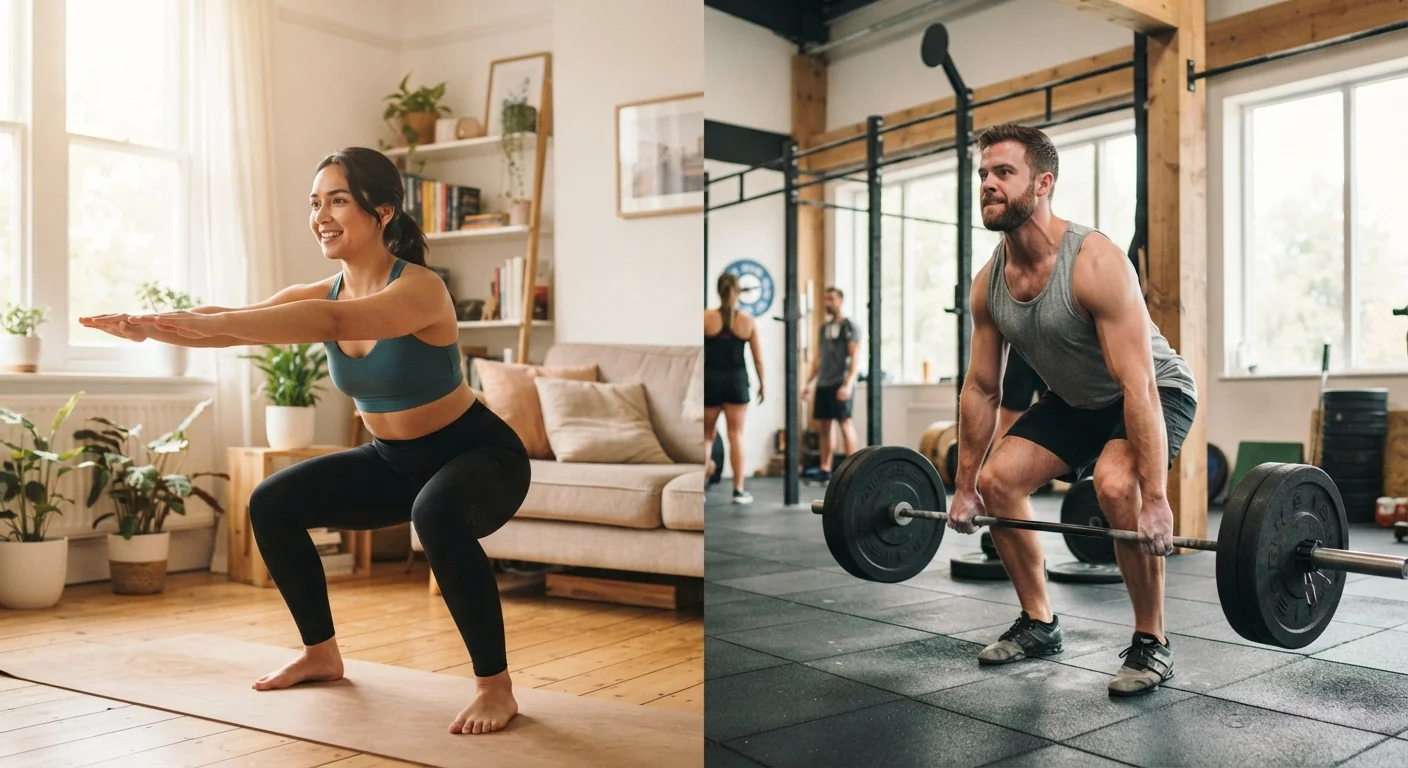
Photo credit: FindersGroove.com | Discover Important Information
In this article
Both home and gym training have genuine advantages and real limitations. Here's how to think through which setup suits your life.
Key Takeaways
- Home workouts remove commute barriers and can be just as effective for many fitness goals.
- Gyms offer equipment variety, professional guidance, and a social environment that some people need to stay consistent.
- Cost, space, motivation style, and specific goals are the most important factors to weigh.
- Hybrid approaches - combining both settings - work well for many people.
- Sustainability matters more than setting: the workout you'll actually do beats the theoretically optimal one.
No commute means fewer excuses to skip
Eliminating travel time removes one of the most common reasons people abandon workout routines. Studies on exercise adherence consistently show that proximity to a fitness facility is a significant predictor of consistency.
Lower long-term cost than most memberships
A modest set of home equipment - resistance bands, a mat, a few dumbbells - can cost less than a single year of gym membership fees and last for many years.
Complete privacy and schedule flexibility
Training at home lets you move on your own timeline, wear what you want, and avoid the social anxiety that gym environments can create for beginners or those returning after a break.
Bodyweight training is genuinely effective
Push-ups, squats, lunges, and core work can build meaningful strength and cardiovascular capacity without any equipment, particularly for those who are new to regular exercise.
Limited equipment ceiling for advanced goals
Serious strength athletes or those pursuing specific sport performance benchmarks will eventually outgrow what most home setups can provide, particularly for heavy compound lifting.
Home environment offers more distractions
Household chores, family members, notifications, and the comfort of familiar surroundings can all chip away at focus and workout intensity in ways a gym setting doesn't typically allow.
No built-in access to professional guidance
Gyms often employ personal trainers and fitness staff who can correct form, suggest progressions, or help you avoid injury - resources that require deliberate effort to find when training at home.
Space and equipment costs can be significant
Creating a functional home workout space in a small apartment can mean rearranging furniture every session or accepting that certain exercises simply aren't feasible in the available square footage.
Why This Decision Feels Harder Than It Should
Fitness culture has a habit of making straightforward questions feel loaded. Should you invest in a gym membership, or carve out a corner of your apartment for home workouts? Online discourse tends to push people toward one camp or the other, often based on aesthetics rather than practicality.
The honest answer is that both environments are legitimate - and both have real limitations. What actually determines success is whether the setup fits your schedule, your budget, your personality, and the kinds of movement you genuinely enjoy. If you're also questioning broader fitness assumptions, our guide to common fitness myths is worth a read before committing to any routine.
The Real Advantages of Working Out at Home
Home training has matured considerably beyond floor exercises and resistance bands, though those remain effective options. Bodyweight training, yoga, online video programs, and even light free weights can address a wide range of fitness goals without requiring a commute or a monthly fee.
No commute means fewer excuses to skip
Eliminating travel time removes one of the most common reasons people abandon workout routines. Studies on exercise adherence consistently show that proximity to a fitness facility is a significant predictor of consistency.
Lower long-term cost than most memberships
A modest set of home equipment - resistance bands, a mat, a few dumbbells - can cost less than a single year of gym membership fees and last for many years.
Complete privacy and schedule flexibility
Training at home lets you move on your own timeline, wear what you want, and avoid the social anxiety that gym environments can create for beginners or those returning after a break.
Bodyweight training is genuinely effective
Push-ups, squats, lunges, and core work can build meaningful strength and cardiovascular capacity without any equipment, particularly for those who are new to regular exercise.
The removal of the commute barrier is frequently underestimated. Research on exercise adherence consistently identifies convenience as one of the strongest predictors of whether someone maintains a habit. When your workout requires only stepping into the next room, the activation energy to start drops dramatically. For people who dislike traditional gym culture, home training can be genuinely liberating.
Where Home Workouts Fall Short
Home training isn't a frictionless solution. Space constraints are real - not every apartment has room for a kettlebell swing or a yoga mat without rearranging furniture. Equipment costs can also accumulate quickly if you try to replicate gym capabilities at home.
Limited equipment ceiling for advanced goals
Serious strength athletes or those pursuing specific sport performance benchmarks will eventually outgrow what most home setups can provide, particularly for heavy compound lifting.
Home environment offers more distractions
Household chores, family members, notifications, and the comfort of familiar surroundings can all chip away at focus and workout intensity in ways a gym setting doesn't typically allow.
No built-in access to professional guidance
Gyms often employ personal trainers and fitness staff who can correct form, suggest progressions, or help you avoid injury - resources that require deliberate effort to find when training at home.
Space and equipment costs can be significant
Creating a functional home workout space in a small apartment can mean rearranging furniture every session or accepting that certain exercises simply aren't feasible in the available square footage.
Perhaps the most significant limitation is motivational structure. Without an external environment cue - the gym floor, other people training, a class starting on time - many people find it genuinely harder to push through a tough session at home. This isn't a character flaw; it's how environmental design affects behavior. If you're comparing this with the social dynamics of group exercise, our article on group fitness vs. solo training explores that dimension in more depth.
What Gyms Actually Offer (and What They Don't)
A well-equipped gym provides access to a range of tools that most home setups can't replicate: cable machines, barbells with heavy plate capacity, cardio equipment with performance tracking, and sometimes swimming pools or dedicated stretching areas. For goals like serious strength development or sport-specific conditioning, this access matters.
~$500-$800
Average annual US gym membership cost
According to data from the International Health, Racquet & Sportsclub Association, the average American gym member pays between $40-$70 per month, though premium facilities can cost significantly more.
~58%
Adults who cite convenience as top exercise factor
Surveys on exercise adherence repeatedly rank proximity and ease of access among the top determinants of whether people sustain a regular movement habit.
Gyms also offer something less tangible: a dedicated space where the social norm is exercising. Many people find that being around others who are training raises their own effort level. If you're curious about how strength and cardio training differ in what they deliver, our breakdown of strength training vs. cardio covers the physiological distinctions clearly.
That said, gyms come with real downsides: monthly fees that add up, peak-hour crowding, commute time, and - for many new exercisers - genuine anxiety about being watched or judged. These aren't trivial concerns.
Gym Anxiety Is Common and Valid
Research suggests that a significant portion of people - particularly those new to exercise or returning after a gap - experience what's sometimes called 'gym intimidation' or 'gymtimidation.' This is a real psychological barrier, not a personal failing. If it applies to you, starting at home, joining a smaller boutique studio, or visiting the gym during off-peak hours are all reasonable strategies. A qualified fitness professional can also help you get comfortable in the environment.
Thinking Through the Decision for Your Situation
Rather than defaulting to whichever option feels more virtuous, it helps to run through a few honest questions. How much space do you have at home? What does your schedule actually look like - not your ideal week, but your real one? Do you tend to perform better with external accountability or with full autonomy? What are your specific movement goals?
Walking as a daily movement practice is one example of a highly sustainable habit that requires no equipment and no membership - a reminder that the best fitness routine is often the simplest one you'll actually maintain. For many people, a hybrid approach - doing most sessions at home with occasional gym visits for heavier lifting or variety - offers the best balance of convenience and capability.
This article is for general informational and educational purposes only and is not a substitute for professional medical or fitness advice. Consult a qualified healthcare provider or certified fitness professional before beginning a new exercise program, especially if you have any existing health conditions.

Author
Health & Wellness Editorial Team
Health & Wellness Editorial Team is the collective byline for our editorial team and contributor network. Articles published under this byline or an editorial pen name are researched, written, and reviewed according to our editorial standards for clarity, consistency, and independence before publication.
View all articles →